

Story
Our Story
How GOVO2 started - and why the tool had to exist.
Twenty years on the trail
Steven and I met volunteering on a nonprofit project more than twenty years ago. That's where the friendship started - with giving roots, which has mattered more than we knew at the time. Somewhere in those first years, we started riding mountain bikes together. That never stopped. Through jobs, moves, marriages, kids, injuries, we've kept riding.
For most of that time, training was just training. I was a former gym rat who liked to stay in shape. Steven was the same. We rode hard, we got stronger, we didn't think too deeply about why.
Then about a year ago, I read Outlive by Peter Attia.
The longevity reframe
Outlive did something to my head that's hard to un-do. It reframed training from a performance question into a longevity question. Not "how strong am I right now?" but "how strong will I be in twenty years, and what do I need to do today to make that true?"
That hit hard, especially as a father. Because fatherhood changes the math on time. I have less of it. Which means every hour I spend training had better be doing more than making me feel good this weekend. It has to be bending a curve I care about.
Steven was already thinking along similar lines. When I told him I wanted to start training with intent - specifically for VO2max, which Attia calls out as one of the highest-leverage longevity signals we can actually measure - he was immediately on board. That's how twenty years of friendship works. You don't have to convince each other of much.
So we started training VO2. Not FTP. Not power for its own sake. VO2 specifically.
The Peloton problem
We both had Pelotons. Pelotons are great for what they are - structured workouts, a screen with numbers, community leaderboards if you want them. But Peloton's entire training grammar is built around FTP. Functional threshold power. That's the number every workout is prescribed against. VO2 doesn't really show up.
So we tried to make it work. We structured VO2 intervals manually. We tried to stay in the right zones by eye. And we got stronger - we could feel it on every ride. But the tool wasn't speaking our language anymore.
The lab testing disaster
So we decided to go get proper VO2 testing. There was a local lab offering gas-exchange VO2 testing in our area. The real thing - you breathe through a mask, they measure oxygen uptake and CO2 output, and you get a VO2max number that's supposed to be the gold standard.
We both went. Got our baselines. Trained hard for months. Our power numbers were rising on both our Pelotons. Our fitness was objectively better. We could feel it on climbs, on intervals, on everything.
Then we went back to get retested.
I sat in the waiting area while Steven did his test. Watched the tester push him past the point where his numbers were already falling. Any methodology reference I'd read said: when VO2 uptake peaks and starts to decline, that's your number. Keep pushing and you're just generating measurement error. The tester kept going. He didn't know the protocol.
My test was next. And when the results came back, both of our VO2max numbers had dropped by 4 to 7 points from baseline. After months of hard training. After objective strength gains we could verify on our own equipment.
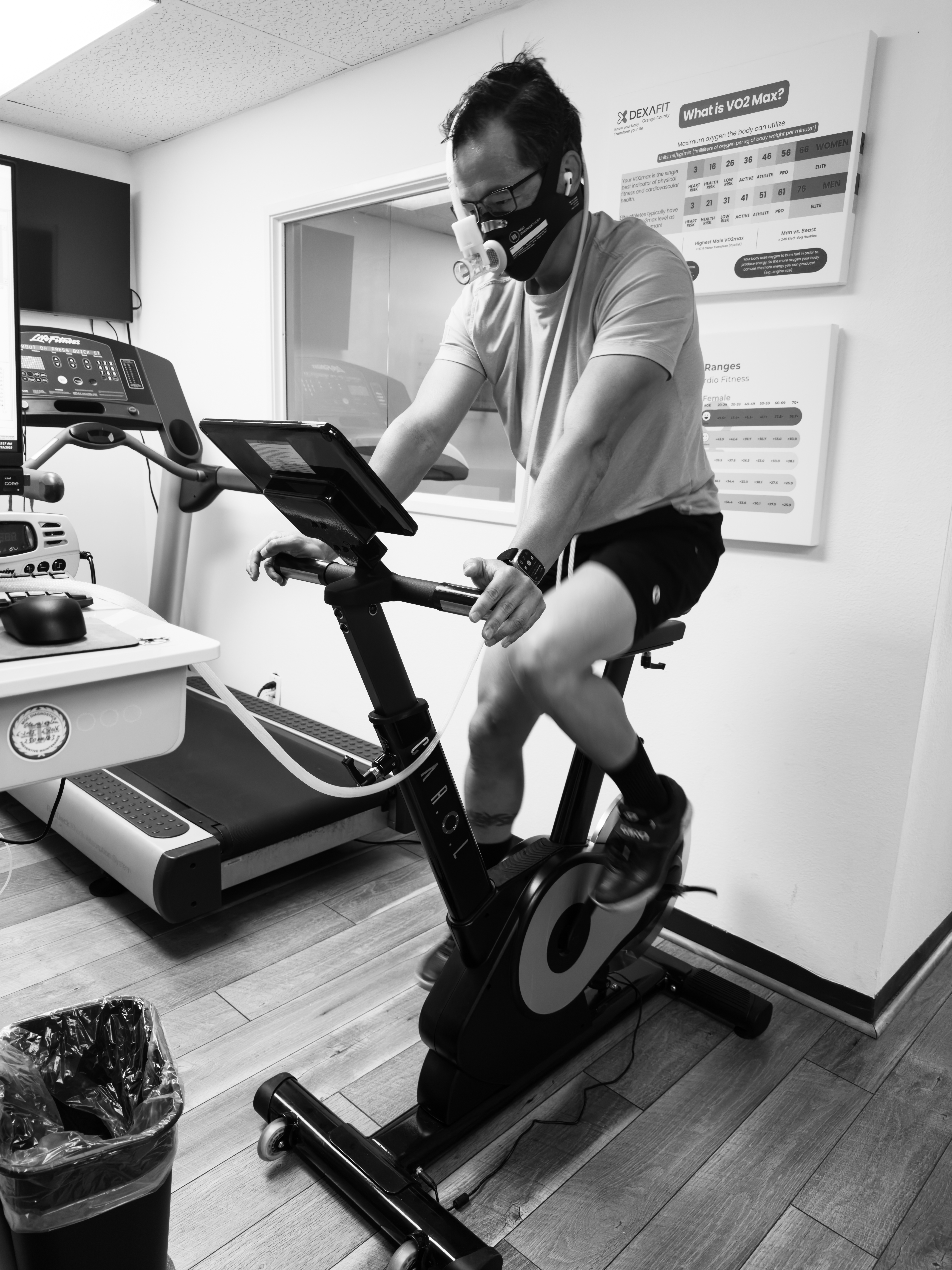
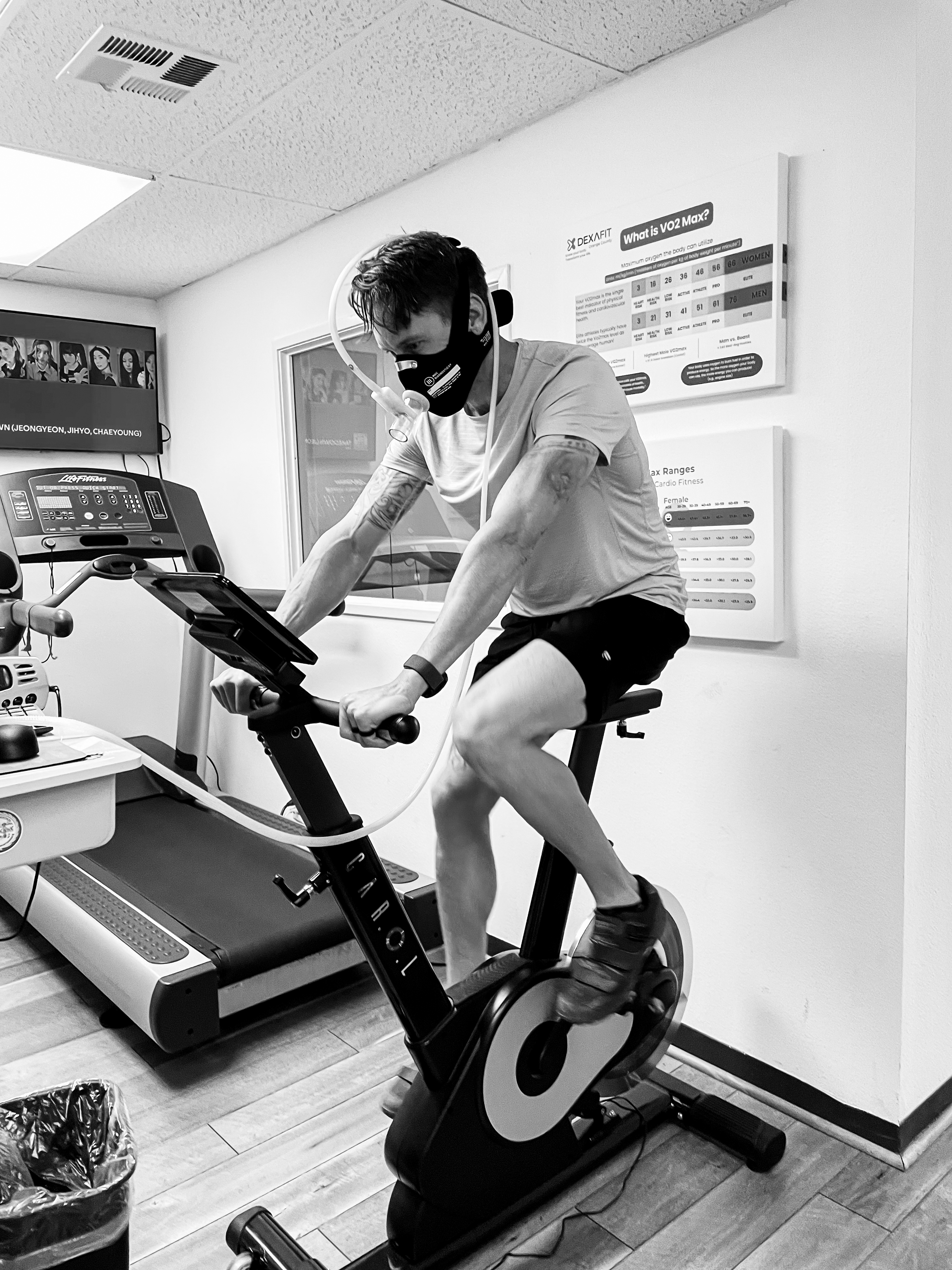
We sat down at lunch afterward, stared at the results, and started running the math.
The engineer's diagnosis
I've spent years in medical device development. So I started looking at what the lab was actually using. Gas-exchange VO2 testing equipment ranges enormously in quality - from room-sized cabinet systems used in sports-science research, down to what was in front of us that day: a handheld mouthpiece roughly the diameter of a cigar.
For the non-engineers reading this: the diameter of the straw you're breathing through affects how hard it is to breathe. When you're at 95% of your maximum aerobic output, any extra resistance is significant. Head loss in a narrow tube is real. And if the equipment is introducing variable resistance from test to test, your "gas-exchange VO2max" number is mostly noise.
Add in operator error - the tester who kept pushing Steven past peak, the inconsistent ramp protocol, the lack of standardized warmup - and we were looking at a system where the measurement error was bigger than the thing we were trying to measure.
The conclusion we reached, over sandwiches:
Whatever error is in the transform from power to VO2 is more acceptable than the measurement error we're dealing with at this lab.
So we moved on.
Power meter pedals
We bought power meter pedals - the real ones, not the Peloton estimate. First finding: our Pelotons were off by about 20 watts. The FTP we'd both been training against for months was lying to us.
Now we had good power. But we didn't have a good workflow. Running a ramp test to estimate VO2max from power requires you to hit specific targets at specific times. Start at 100 watts. Add 25 watts every minute. Stay within range. Note the exact wattage and elapsed time when you fail.
Our workflow looked like this: I would write power targets and times on a Post-it note. Tape it to the top of the Peloton screen. Try to hit the numbers while the power meter display waved around. Fail at some point. Write down the approximate value. Plug the estimates into a formula afterward to get VO2max.
Two adult men. Twenty years of riding. Engineering backgrounds. Post-it notes on a screen.
The Garmin Fenix 8
There was an obvious out, and I tried it. A Garmin Fenix 8. Garmin is the gold standard for serious cycling - proper protocols, proper VO2max estimation, proper head units. If we wanted cycling-grade training data, we could just buy in.
I put it on my wrist. Spent about ten minutes trying to figure out how to operate it.
And then I said: I do not have time for this.
Kids, wife, in-laws, running a company, going zero to a hundred on AI. There was no mental surface area available to learn another ecosystem. Another app. Another sync layer. Another set of muscle memory. The Garmin wasn't a bad product - it was just asking for bandwidth I didn't have.
Right after I put the Fenix 8 down, I thought: I could probably just go build something now.
That's the moment GOVO2 started. Not a long deliberation. Not a market study. Ten minutes and a realization that the tool I wanted didn't exist and I could build it.
Why we're publishing this
A week later, we have an app. It runs a ramp test from your power meter. It takes HR from your Apple Watch. It estimates VO2max using Coggan-family equations. It shows the math. It lives on the watch you already wear.
It's the tool Steven and I wanted. If you're the cyclist we've been describing - on Apple Watch, training structured, tired of being measured as a walker, not interested in switching ecosystems - it's probably the tool you wanted too.
We built it first for ourselves. We're releasing it free for everyone.
If you're here, thanks for reading this far. The story mattered to us; that's why we took the time to write it down. The product is downstream of it.
- Jason & Steven